Blog
GREEDY vs EVENLY: Choosing a Pacing Regime (and Why the Trickle Floor Matters)
Two campaigns, identical budgets, identical goals — and completely different delivery curves. Here's when to front-load spend with GREEDY, when to spread it with EVENLY, and why a minimum 'trickle floor' keeps a line item alive when supply disappears.
- Author
- Ad360 engineering
- Discipline
- Platform engineering
Take two campaigns with the same budget, the same impression goal, and the same hour to spend it in. Run one in GREEDY mode and one in EVENLY mode, and you will get two completely different delivery curves — both of which hit the goal. One races to the target early and then goes quiet; the other tracks a steady diagonal and arrives at the buzzer. Neither is "correct" in the abstract. Choosing between them is one of the most consequential — and least understood — decisions in campaign delivery.
A companion piece argues the broader point: pacing is a real-time control problem, not budget divided by hours. This article is narrower and more practical. It is a decision guide for the two regimes, the guardrails that keep each one sane, and the quiet mechanism — the trickle floor — that decides what happens when supply simply isn't there.
The two regimes, precisely
Both modes pursue the same goal. They differ in when they spend.
- EVENLY spreads participation so that cumulative delivery follows the expected, roughly straight-line pace across the interval. It varies how often it bids — moment to moment — precisely so that progress stays on the expected curve as supply rises and falls.
- GREEDY captures delivery as early as conditions allow — but with guardrails. Its effective participation rate is capped (at 0.5 in the tested configuration, with a lower GREEDY floor around 25%). "Greedy" therefore means front-loaded within limits, not all-in. It does not bid on everything; it leans forward inside a bounded band.
That cap is important and frequently missed. A naive "spend it fast" mode would exhaust budget in minutes on a supply spike. The real GREEDY is bounded greed: aggressive early, but never uncapped.
What it looks like under normal supply
Under moderately noisy but centered conditions — a simulation at roughly 1,500 QPS with a 10,000-impression goal — the two regimes draw distinctly different curves. GREEDY reaches the full goal by around minute 23 of the hour and then stops bidding for the remainder. EVENLY tracks the expected diagonal almost exactly and arrives at the same goal near the end of the hour. Same destination; opposite trajectories.
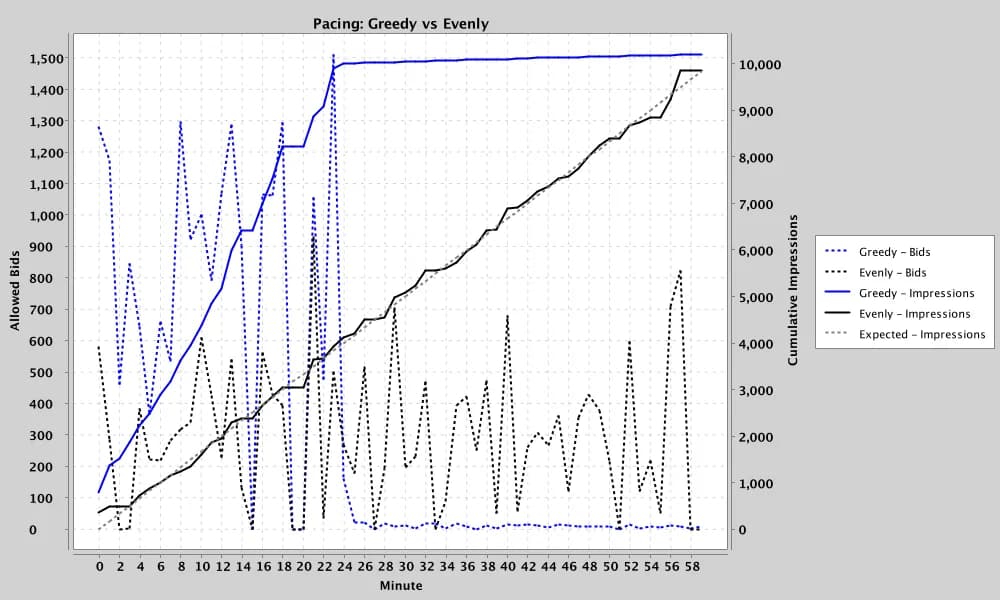
The chart is the whole argument in one image. The difference between the modes is not whether they deliver — it is the shape of how they deliver, and that shape has real consequences for price and risk.
When to choose which
The choice is a bet about the future of supply and the value of speed.
Choose GREEDY when:
- Supply is fragile or time-limited — an event, a daypart, or inventory you expect to thin out later. Capturing delivery while it exists beats hoping it returns.
- Learning speed is valuable — getting impressions (and outcomes) early feeds optimization sooner, which matters most for new line items.
- You would rather bank delivery now than risk a late-flight shortfall.
Choose EVENLY when:
- You want consistent all-day presence — branding and reach goals that benefit from being visible across the whole interval, not just its first third.
- You want smoother average prices — concentrating bids into a short window can mean competing harder, and paying more, exactly when you are most aggressive.
- Supply is broadly stable, so there is no urgency to front-load.
Each has a failure mode, and naming it is the point:
- GREEDY can exhaust budget before better or cheaper supply appears later in the interval.
- EVENLY can fall short if supply collapses late, after it has paced conservatively expecting a normal curve.
There is no free lunch. The regime is a deliberate trade between the risk of spending too early and the risk of spending too late.
The trickle floor: staying alive when supply vanishes
Now the case that separates a real controller from a quota. Hold the match rate down near 0.001 for an entire hour. The 10,000-impression goal is physically unreachable — the inventory does not exist. What should a pacing system do?
The wrong answers are to thrash (burning everything on the rare match that appears) or to go completely dark (giving up and losing presence entirely). The right answer is the trickle floor: a minimum level of participation that keeps the line item minimally in the auction — accumulating a small fraction of the goal, staying warm, and ready for the moment supply returns. The floor also applies defensively when goals are zero or invalid, so a misconfiguration never silently switches a line item off.
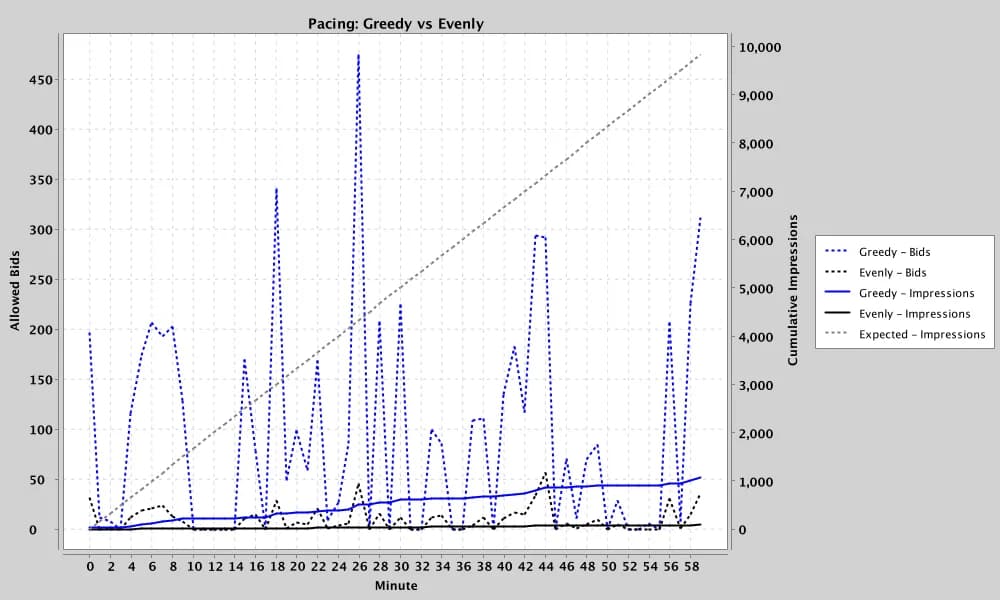
This is what "honest pacing" looks like under scarcity: the system keeps a pulse, reports the shortfall truthfully rather than disguising it, and does not pretend to deliver inventory that was never there. Failing gracefully is a feature; faking delivery would be a bug.
Why the floor protects learning, not just presence
The trickle floor is easy to read as a mere "stay visible" mechanism, but its deeper value is learning continuity. A line item that goes fully dark stops gathering the outcome signal that pacing and optimization depend on; when supply returns, it is cold. By keeping a minimal, regulated flow of impressions, the floor preserves the feedback loop — so the moment conditions improve, the line item is already warm rather than starting from zero. Combined with cold-start protection and smoothed pacing memory, it means scarcity degrades performance gently instead of resetting it.
Common misconceptions
- "GREEDY means spend as fast as possible." It is bounded — capped effective rate (0.5) with a ~25% floor — not uncapped.
- "EVENLY means equal bids each hour." It means equal progress against the expected curve, achieved by varying participation as supply varies.
- "One mode is simply better." Each wins under different supply assumptions and goals; the choice is a trade-off, not a ranking.
- "The trickle floor wastes budget." It spends minimally to preserve presence and learning when the goal is unreachable — the alternative is going cold.
- "Under-delivery means the mode failed." Often it means supply was genuinely absent, and the floor behaving correctly is the honest outcome.
What good operation looks like
- Match the mode to the goal: branding and steady presence → EVENLY; fragile/time-limited supply and fast learning → GREEDY.
- Read delivery against the expected curve, not against the clock.
- Treat a trickle-floored, under-delivering line item as a supply signal — investigate targeting, floors, and inventory before reflexively raising bids.
- Trust graceful recovery and resist manual end-of-flight dumping.
Open questions
- Can the mode itself — greedy vs even, and the floor values — be learned per line item rather than configured?
- How should regime choice adapt to curated or constrained supply, where the available pool is deliberately narrowed?
- What is the right floor level to preserve learning without meaningfully diluting delivery?
GREEDY and EVENLY are not settings you pick once and forget. They encode a hypothesis about how supply will behave and how much you value speed over smoothness — and the trickle floor encodes a commitment to stay honest when that hypothesis meets a market that has nothing to sell. Pick the regime on purpose, read the curve instead of the clock, and let the floor do its quiet job when the inventory disappears.