Blog
Why "No Bid" Happens: A Field Guide to Win-Rate Loss
Most of the time, a bidder says no. For every opportunity that becomes a bid, many more are declined — and each no-bid has a reason. This is a field guide to those reasons: which are healthy, which are fixable, and how to read a loss distribution instead of guessing.
- Author
- Ad360 engineering
- Discipline
- Platform engineering
The dirty secret of real-time bidding is that the bidder mostly says no. For every opportunity that becomes a bid, many more are declined — filtered out, paced down, priced out, or simply never matched. To an operator watching a campaign under-deliver, all of those look the same: silence. But they are not the same at all. Each no-bid has a specific reason, and reading those reasons is the difference between diagnosing a delivery problem and guessing at it.
A companion piece walks through the full decisioning funnel — how an opportunity becomes a bid. This one inverts the lens. It is a field guide to the losses: the categories of no-bid, which ones are healthy and which are fixable, and how to read a loss distribution rather than panic at a low win rate.
A no-bid is not a failure
Start by killing the instinct that drives bad decisions: the belief that a no-bid is a mistake. It usually is not. Most no-bids are correct — the opportunity genuinely failed a constraint the campaign set. A creative that does not fit the slot, a request outside the geo-fence, a price floor above the line item's willingness to pay: declining these is the bidder doing its job. The goal is never to bid more often. It is to bid on the right opportunities and to understand the ones you decline.
So the useful question is not "why is my win rate low?" but "where are my opportunities being lost, and is that loss healthy or accidental?"
The categories of loss
Drawn from the named stages of a production win-rate waterfall, no-bids fall into a handful of meaningful categories, in roughly the order they occur:
- Eligibility and candidate loss. No eligible line item, no candidate, no commercial context (billing/deal). The opportunity had no buyer who could want it under the available terms. Mostly structural.
- Hard targeting loss. The big one. Inventory type, viewability, slot visibility, historical CTR, OS, device, creative type/size, native placement, language, day/hour parting, geo, hyperlocal, CPM floor. Each is a near-binary constraint that can correctly end the decision. Mix of healthy and fixable.
- Context and audience loss. Domain rules, contextual taxonomies, audience segments, first-party audience. Selective by design — this is where a large share of survivors drop out. Usually healthy; a collapse signals over-narrow targeting.
- Pacing loss. The pacing cap and controller declined to participate, not because the opportunity was bad, but because now was the wrong moment to spend. Healthy if delivery is on curve; investigate if not.
- Allocation/selection loss. Slots allocated, empties removed, a winner chosen — opportunities that survived everything but were not selected. Largely mechanical.
The point of the taxonomy is that these categories carry different meanings. A no-bid at "creative sizes" tells you something completely different from a no-bid at "pacing controller."
Reading the loss distribution
The win-rate waterfall is not just a record; it is a diagnostic instrument. Plotted as a bar per stage — the share of opportunities surviving each gate, shaded from green (most survive) to red (few) — its shape tells the story.
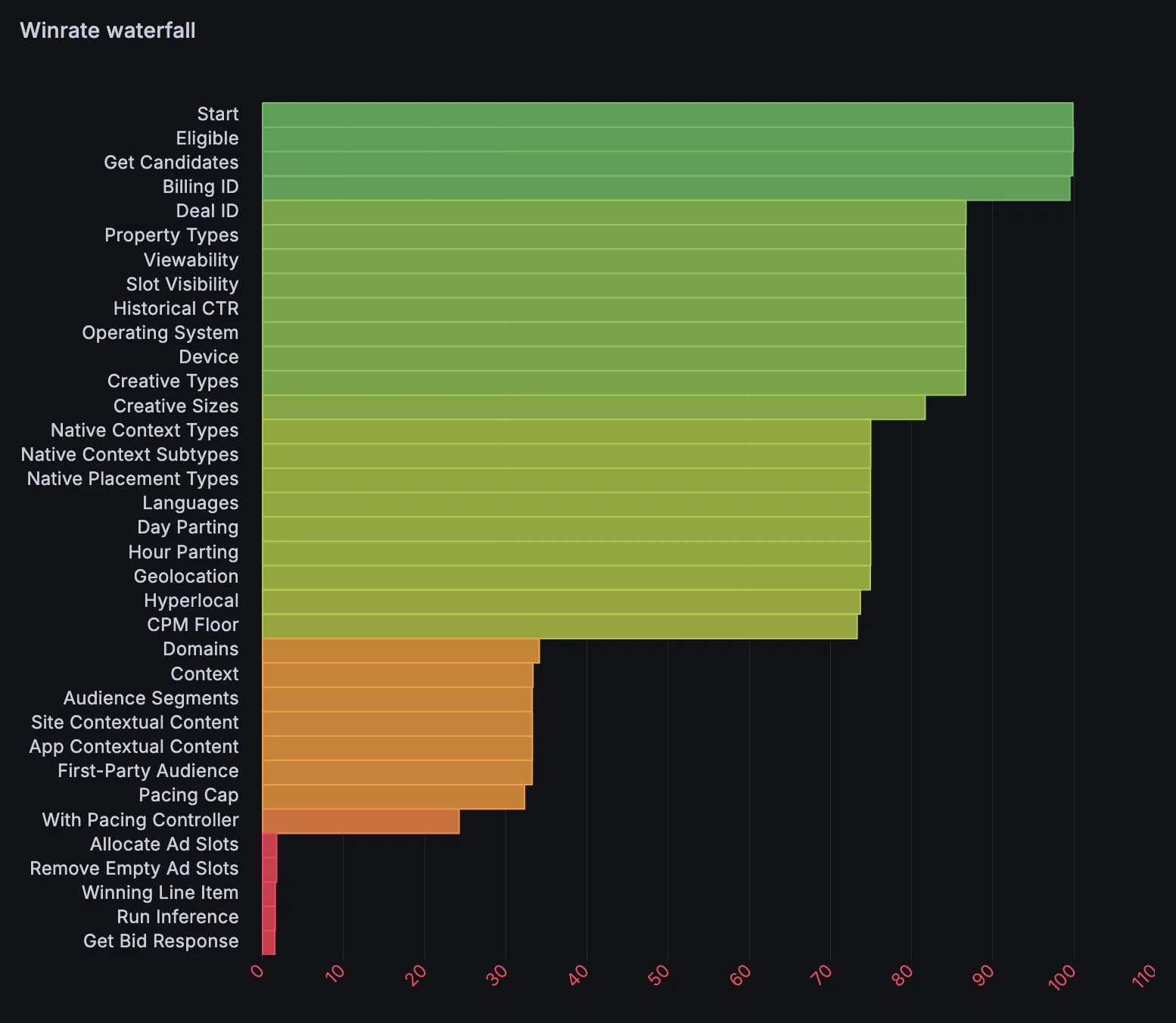
Read it like this:
- A sharp single-stage drop flags a misconfiguration. An unexpectedly large fall at Creative Sizes suggests creatives that don't fit available slots — a fixable problem, not a market one.
- A healthy amber band at contextual/audience stages is normal selectivity. A collapse there means targeting is too narrow.
- A deep cut at a hard filter (geo, floor, day-parting) may be entirely correct — or a fence drawn too tight, a floor set too high. The waterfall tells you where to look; judgment tells you which it is.
- The final red stages (pacing, allocation, inference) are where the surviving few become actual bids — losses here are expected.
Read this way, win rate stops being a single opaque number and becomes a map of where and why opportunities are lost.
Healthy attrition vs. accidental over-filtering
The central skill is telling these apart. Healthy attrition is the funnel doing its job — declining inventory the campaign genuinely shouldn't buy. Accidental over-filtering is the funnel removing opportunities it should have kept, because of a setup error: a creative-size mismatch, a stale targeting rule, a floor inherited from a different campaign, a contextual segment that never matches.
The tell is surprise. A drop you can explain from the campaign's strategy is attrition. A drop you cannot explain — or one that doesn't match intent — is the bug. The waterfall surfaces the surprise; it cannot interpret it for you.
Common misconceptions
- "Low win rate is bad." Win rate is a function of how selective the campaign is; a low rate with correct attrition is fine.
- "A no-bid is a lost opportunity." Most no-bids are opportunities the campaign correctly declined.
- "To deliver more, bid more often." Often the fix is removing an accidental filter, not loosening every constraint.
- "All losses are equal." A creative-size loss and a pacing loss demand completely different responses.
- "You can diagnose delivery from the totals." You need the distribution of losses across stages, not a single win-rate number.
What good operation looks like
- Treat the win-rate waterfall as the first stop when delivery drifts, before touching targeting.
- Distinguish structural attrition (a floor too high for the inventory) from accidental attrition (a size mismatch).
- Investigate single-stage cliffs — they're usually misconfiguration.
- Read pacing losses against the delivery curve, not in isolation.
- Resist the reflex to loosen everything; fix the specific stage that's wrong.
Open questions
- Can loss reasons be classified automatically into "healthy" vs "fixable" rather than read by eye?
- What's the right way to alert on an anomalous loss distribution before a campaign under-delivers?
- How should loss diagnostics be exposed to buyers without revealing competitive bid logic?
A low win rate is not a verdict; it is a question. Most no-bids are the bidder correctly declining inventory the campaign didn't want. The job is to read the loss distribution, separate the healthy attrition from the accidental, and fix the one stage that's actually wrong — instead of yanking every lever and hoping. The waterfall turns "we're under-delivering" into "we're losing too much at creative sizes." That sentence is the whole difference between operating and guessing.